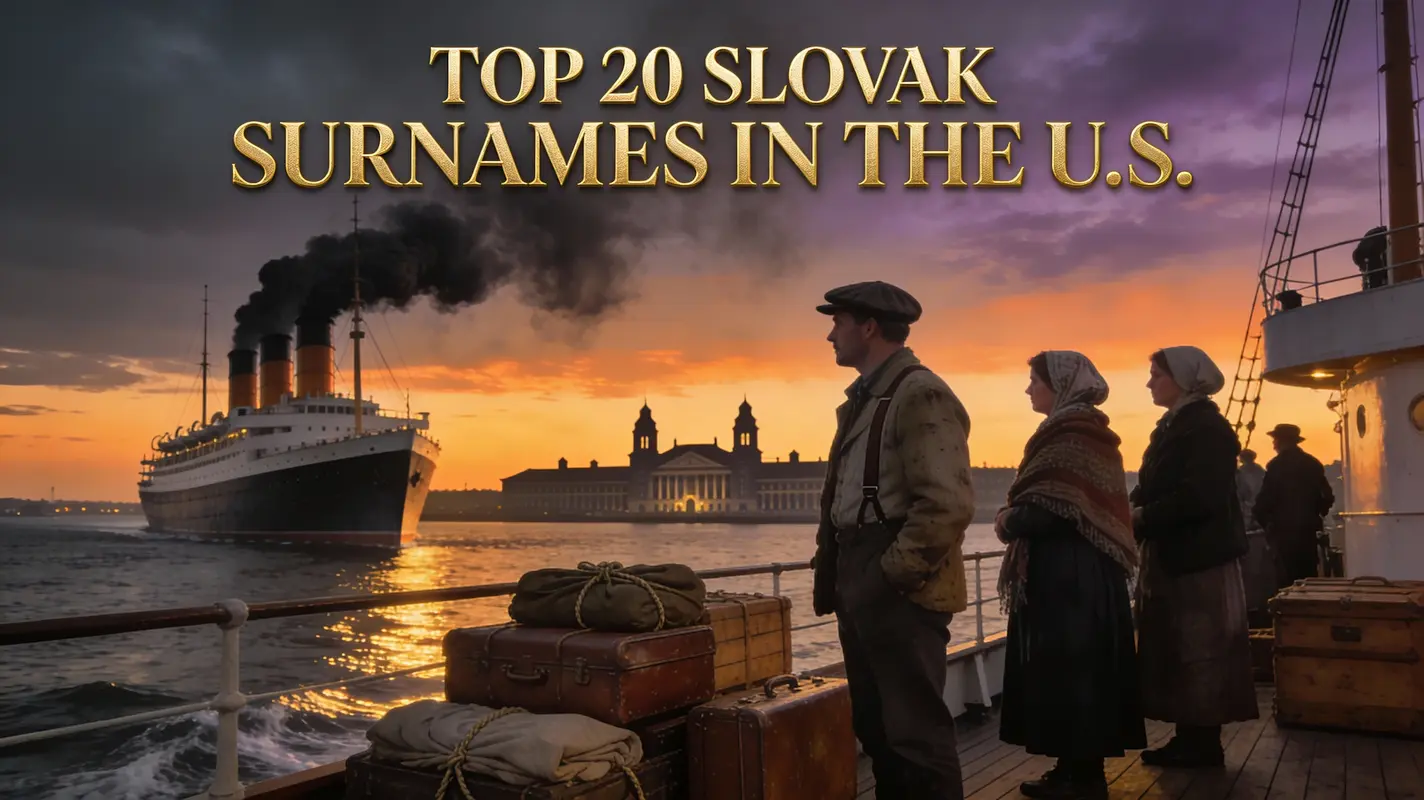
Slovak surnames in the United States are the product of migration from the former Kingdom of Hungary, later Czechoslovakia, mainly between the 1880s and 1920s and then again after 1948 and 1968. Names were bent, simplified, and sometimes completely changed by American clerks, typewriters, and later databases, which means Slovak Americans often carry “Hungarian” or “German” looking surnames that still point back to Slovak villages. The list below focuses on 20 very frequent and recognizable surnames tied to Slovak communities and records in both Slovakia and the U.S.
1. Horvath / Horváth
Horvath (originally Horváth) is one of the most common surnames in Slovakia and across the former Hungarian Kingdom. It literally means “Croat,” but in practice it marks families who once had some Croatian connection or simply carried a very common regional name.
In the U.S., Horvath usually appears without accents and is heavily concentrated in states that attracted early Slovak immigrants: Pennsylvania, Ohio, New Jersey, and Illinois. In older passenger lists and church records, the same family can be written as Horváth, Horwath, Horvat, or Horwatt, so surname plus village is always more reliable than spelling alone.
2. Kováč / Kovac / Kovacs
Kováč is the classic Slavic occupational surname for “smith,” functionally equivalent to Smith in English. Because almost every region had blacksmiths, the name spread widely throughout Slovakia, Moravia, and northern Hungary.
In American records, diacritics disappear and you typically see Kovac, Kovach, or Kovacs. Many Slovak Americans with this name have ancestors from central and eastern Slovakia, and some lines show both Slovak Kováč and Hungarian Kovács forms in different records.
3. Varga
Varga is originally a Hungarian occupational name meaning “cobbler” or “shoemaker,” but it is firmly rooted in Slovak communities as well. It appears among the top surnames in current Slovak statistics, especially in mixed Slovak–Hungarian regions.
In the U.S., Varga stayed relatively stable in spelling, which makes it easier to track across censuses, draft registrations, and naturalization files. What complicates research is ethnicity labeling: the same ancestor might be listed as Hungarian in 1910 and Slovak or Czechoslovak in 1930.
4. Nagy
Nagy means “big” or “great” in Hungarian and is one of the most common surnames across Hungary and southern Slovakia. It often started as a descriptive nickname and slowly became a hereditary family name.
Among Slovak Americans, Nagy is frequent in communities whose ancestors came from counties like Košice, Nitra, and southern parts of present-day Slovakia. Because it is ethnically ambiguous, you always need the village name or at least the historical county to decide whether a Nagy line was Slovak-speaking, Hungarian-speaking, or mixed.
5. Tóth / Toth
Tóth (modern Slovak spelling Tót is rare) historically meant “Slav” or “Slovak,” so the surname literally labels someone as “the Slovak” in a Hungarian-speaking environment. For that reason, it is extremely common in areas where Slovaks and Hungarians lived side by side.
In the U.S., accents drop and the surname becomes Toth, sometimes written as Tote or Tooth in misread records. For many families, this name is a strong indicator of Slovak origin, but only combined with place names and church affiliations in the records.

6. Szabó / Szabo / Sabo
Szabó means “tailor” in Hungarian, another typical occupational surname that took root in Slovak towns and villages. Village tailors often served multi-ethnic communities, so Szabó families can be Slovak, Hungarian, Jewish, or a mix.
In America, Szabó became Szabo or Sabo, and the spelling can even shift within a single family over decades. Because of that, any research into this surname has to combine church records, language in the household, and immigration documents to understand the exact background.
7. Baláž / Balaz / Balazs
Baláž comes from the personal name Blažej (Blasius), with Hungarian Balázs as a close cousin form. In modern Slovakia it sits among frequent surnames, particularly in central and eastern regions.
In the U.S., Baláž usually appears as Balaz or Balas, and sometimes Balazs. These small differences matter when searching old indexes, so researchers often have to check several adjacent spellings to reconstruct one family.
8. Lukáč / Lukac / Lukacs
Lukáč comes from the given name Lukáš (Luke), and variants appear across Slovakia, Hungary, and Rusyn regions. The surname clusters strongly in northeastern Slovakia and in Greek Catholic and Roman Catholic parishes.
In American sources, you will find Lukac, Lukach, Lukacs, and sometimes Lukas used as a surname. This flexibility means that a solid search plan has to combine all variants, especially when dealing with poorly indexed naturalization files or ship manifests.
9. Novák / Novak / Nowak
Novák is a pan-Slavic surname meaning “new man” or newcomer. In Slovakia, as in Czechia and parts of Poland, it is a classic frequent name that says more about social status than ethnicity.
In the U.S., Novak overlaps heavily with Czech and Polish communities, and the Polish form Nowak adds to the confusion. For Slovak Novak lines, the real key is the specific village or at least the district, not the surname itself.
10. Molnár / Molnar / Molner
Molnár is Hungarian for “miller,” another occupational surname that took hold across Slovakia. Mills were central economic points in rural communities, so miller families often had wide networks through marriage and godparent ties.
In American paper trails, Molnár is often simplified to Molnar or Molner, and sometimes partially translated to Miller. When the surname suddenly changes from Molnar to Miller between immigration and the first U.S. census, cross-checking draft cards and naturalization papers usually exposes the link.
11. Kráľ / Kral / Kralik
Kráľ literally means “king” in Slovak, and like many “royal” surnames, it started as a nickname or status marker. Variants such as Kral and Kralik are common in Slovakia and neighboring countries.
In U.S. records, the accent vanishes and the name appears as Kral or Kralik. Researchers must check carefully to distinguish unrelated Kral and Kralik families who met later in American industrial towns but came from different regions of Slovakia.
12. Marek
Marek is both a given name (Mark) and a surname in Slovakia and surrounding areas. Families may carry it in one generation as a given name and in another as a fixed surname, which creates layered naming patterns.
In the U.S., Marek retains its form fairly well, but appears in Czech and Polish communities too. The safest way to confirm Slovak origin is to find the exact birthplace in naturalization papers or ship manifests rather than relying on the surname alone.
13. Janoš / Janos / Janošík and variants
This group of surnames goes back to the given name Ján / János (John), one of the most popular male names in the region. Diminutives such as Janošík or Janosek also developed into independent surnames.
In American documents, Janos and Janosek are common, and sometimes the name is anglicized partially, for example to Johnas. Because the base given name is so common, evidence from parish books and village clusters is crucial to untangle different Janos lines.
14. Urban
Urban originates from the Latin name Urbanus and appears as both given name and surname across Central Europe, including Slovakia. Several Slovak villages show tight clusters of Urban families in church registers.
The surname arrived in the U.S. with Catholic and Lutheran immigrants from Upper Hungary and often remained unchanged in spelling. The challenge is not the form but the sheer number of unrelated Urban families who later lived in the same American steel and coal towns.
15. Farkaš / Farkas
Farkaš is the Slovak form and Farkas the Hungarian form of a surname meaning “wolf.” It began as a nickname and spread widely into eastern and southern Slovakia.
In American records, spellings like Farkas, Farkash, and Farkosh appear, often in the same extended family. Checking given names, religion, and naturalization witnesses helps link the correct branches together.
16. Adamčík / Adamcik / Adamik
Adamčík and Adamik are diminutives based on the given name Adam, common in Slovak and neighboring cultures. In Slovak parish records these surnames usually keep diacritics, which vanish once the family arrives in the U.S.
On American soil, the name appears as Adamcik, Adamchik, or Adamik. For genealogical reconstruction, it is standard to search all of these spellings in combination with one or two target villages in present-day Slovakia.
17. Babjak
Babjak is a recognized Slovak surname with documented clusters in specific regions, especially in central and eastern Slovakia. Its exact original meaning is debated, but by the 19th century it was a normal hereditary surname.
In the U.S., Babjak appears mostly intact, with occasional variants like Babjack or Babiak. This makes it relatively easier to track across records compared to more heavily modified surnames, although you still need birthplace data to distinguish unrelated lines.
18. Roth
Roth is a German surname meaning “red” or linked to cleared land, common among Germans and Jews in Central Europe. It shows up in Slovak surname statistics and in the records of towns that historically had German-speaking or Jewish communities.
Slovak Americans with the surname Roth therefore may have Slovak, German, or Jewish roots from Slovak territory. To avoid wrong assumptions, serious research looks first at religion, language used in records, and exact locality rather than only at the surname form.
19. Klein
Klein is another German surname, meaning “small,” widely present in areas that now belong to Slovakia. Just like Roth, Klein often appears in Jewish registers and German Lutheran or Reformed church books.
In U.S. contexts, Klein is very stable in spelling, which helps with searching but hides the underlying diversity of origins. Only by linking back to a specific town in today’s Slovakia can you correctly classify a “Slovak American” Klein line.
20. Frank / Frankl / Franko
The Frank surname group comes from the old ethnonym “Frank” and later from the given name of the same form, spreading across German and Slavic areas. In Slovak lands it appears in German, Jewish, and Slovak families, especially in towns with mixed populations.
In the U.S., Frank and Franko are frequent in communities with roots in present-day Slovakia, while Frankl is more strongly connected to Central European Jewish families. As with several other names on this list, the surname alone is not proof of ethnicity; the decisive evidence sits in ship manifests, naturalization files, and church records that explicitly name a birthplace in Slovakia.