When Americans start researching their Slovak ancestors, they expect a familiar workflow: census lookups, indexed databases, smooth searches, predictable records. Then they hit the Slovak brick wall in the first hour. The reason is simple. Slovak genealogy is not built on the same infrastructure, habits, or record-keeping systems as the United States. It requires a different mindset and far more manual work.
Here’s the reality.
1. The Records Were Not Created for Genealogists
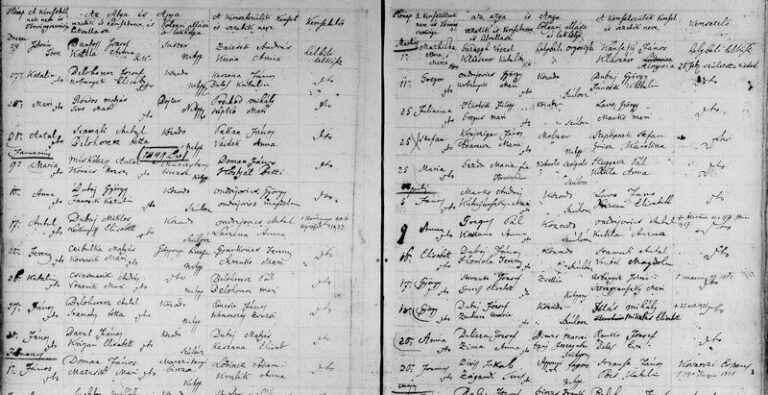
In the U.S., many historical documents were standardized early. Slovak records were created by churches whose priority was liturgy, not future research. Each priest wrote in his own format, handwriting style, and accuracy level. The same family name can appear in multiple spellings on one page. Some priests recorded every detail. Others wrote only bare minimums.
Impact: You waste time deciphering handwriting and guessing spelling variations.
2. There Is No Central Archive System Like in the U.S.
You won’t find a “Slovak Ancestry National Database.” There is no equivalent to Ancestry’s census collections or Social Security Death Index. Records are scattered across multiple regional archives, local villages, parish offices, and digitization projects. Some books are online. Some are on microfilm. Some are still in a priest’s cabinet.
Impact: You spend time searching for where records are kept instead of researching ancestors.
3. Language and Script Change Every Few Decades
A single village might have records written in:
- Latin
- Hungarian
- Slovak
- German
- Cyrillic (rare but possible in Rusyn/Orthodox parishes)
Between 1780 and 1950, the languages and administrative systems changed repeatedly. A surname can look different in each language. A priest may mix multiple languages in one entry.
Impact: You need to navigate several languages and scripts to follow the same family line.
4. Villages Changed Names, Borders, and Administrative Units
Your ancestor’s village may appear under:
- a Slovak name
- a Hungarian name
- a German name
- an obsolete historical name
- a district that no longer exists
A village can also split, merge, or change parish affiliation. You can’t rely on modern maps.
Impact: You often can’t find the village because you’re searching for the wrong name.
5. No National Censuses With Full Family Structure
The U.S. censuses are powerful because they list entire households and occupations. Slovakia (formerly Upper Hungary within Austria-Hungary) didn’t run recurring population censuses with genealogical detail. Only a few fragmented censuses exist, and most lack full names.
Impact: You can’t rely on a simple census chain. You must build families manually from church books.

6. Frequent Spelling Variations
In America, spelling stabilizes early. In Slovakia, spelling stayed fluid into the 20th century. Priests wrote phonetically based on their language. So one ancestor’s surname can appear as:
- Macsay
- Matzai
- Macai
- Macsai
- Máczaj
- Mácsai
All in the same parish.
Impact: Searches fail unless you know all relevant variations.
7. Migration Within Slovakia Was Common
People moved for seasonal work, marriage, land, or mining. A family may appear in three villages within two generations. There are no easy clues pointing to the previous village.
Impact: You can get stuck in the “wrong” village without realizing the family moved.
8. Privacy Restrictions on Modern Records
Slovak civil records have strict access rules:
- Births: closed for 100 years
- Marriages: closed for 75 years
- Deaths: closed for 30 years
Access requires proof of direct descent, and even then, each office handles requests differently.
Impact: Your research timeline ends abruptly if you can’t access 20th-century civil documents.
9. Many Records Don’t Survive
War, fire, poor storage, humidity, and political instability damaged or destroyed parish books. Some parishes have full sets. Others have gaps of 20–60 years.
Impact: You must reconstruct lines using indirect evidence instead of direct records.
10. Misconception: “It’s All Online”
Digitization by the Slovak archives, Hungary, FamilySearch, and volunteer projects is improving. But not everything is online, and what exists online is often not indexed. You still scroll through hundreds of pages manually.
Impact: Expect more time investment and fewer shortcuts.
What This Means for Your Research
If you approach Slovak genealogy with American expectations, you will get stuck. You need to adapt to:
- unpredictable records
- multiple languages
- non-indexed sources
- shifting village names
- slow bureaucratic processes
Slovak genealogy is fully doable. It just doesn’t follow American rules.
If you want a structured system for Slovak genealogy, my ebooks give you step-by-step workflows, name variations, maps, and templates that eliminate weeks of trial-and-error.