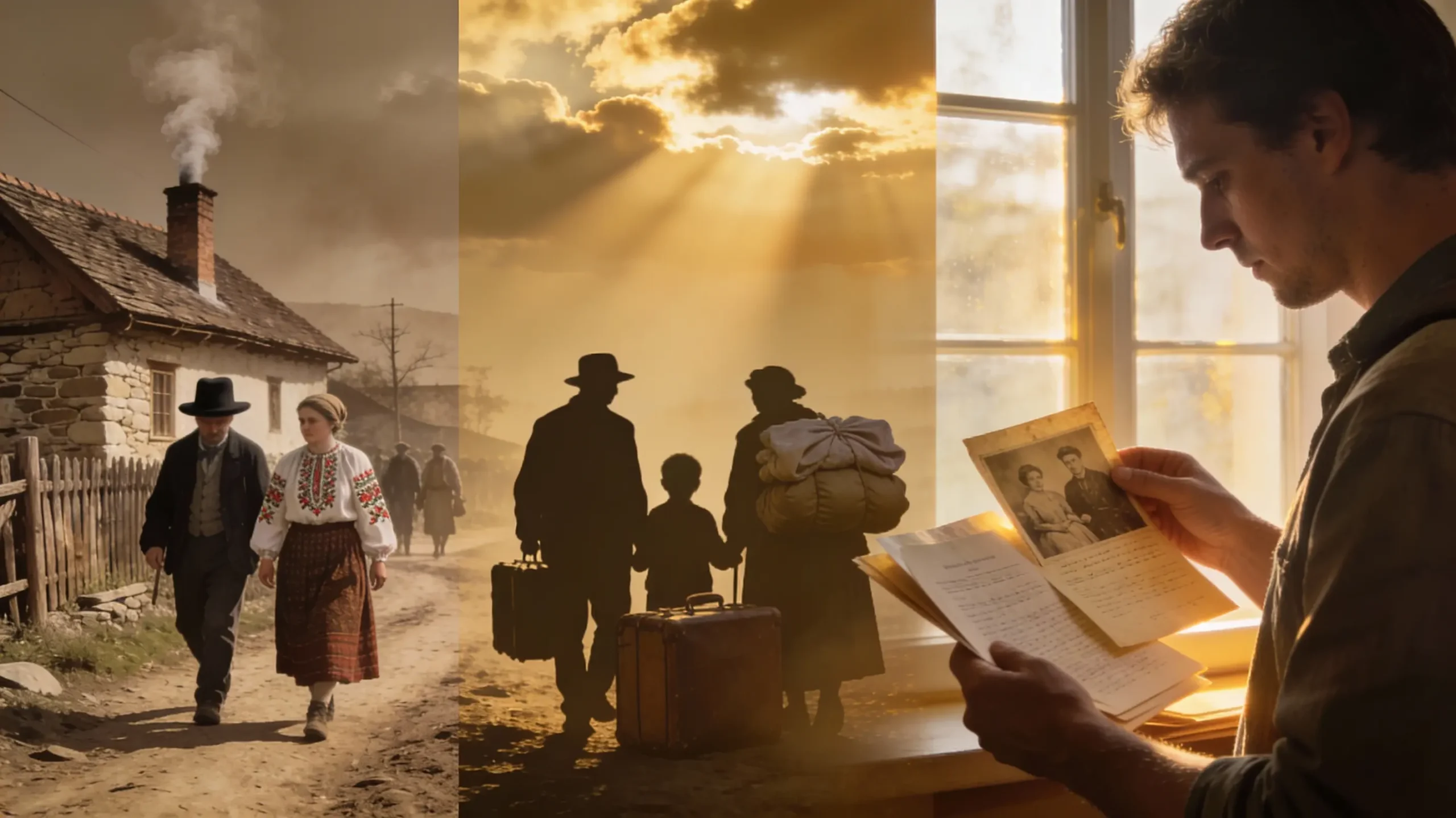
Slovak surnames are not random labels; they are compressed stories about origin, language, status, occupation, religion, and migration paths. When you know how to read them, your surname becomes a fast shortcut into where your ancestors lived, what they did, and who they lived among.
1. How Slovak Surnames Were Born
Most Slovak surnames stabilized between the 16th and 19th centuries, under the Kingdom of Hungary and later within the Habsburg monarchy. Local priests, notaries, and tax officials pushed families to use fixed hereditary family names, which then froze into church and civil registers.
Four big forces shaped your Slovak surname:
- Administration in Latin, later Hungarian and German, which affected spelling and endings.
- Religion and parish structure (Roman Catholic, Greek Catholic, Lutheran, Reformed, Jewish), which decided which books your surname sits in.
- Multi-ethnic environment: Slovaks lived mixed with Hungarians, Germans, Rusyns, Jews, Croats, and others, so “Slovak” surnames can look Hungarian or German at first glance.
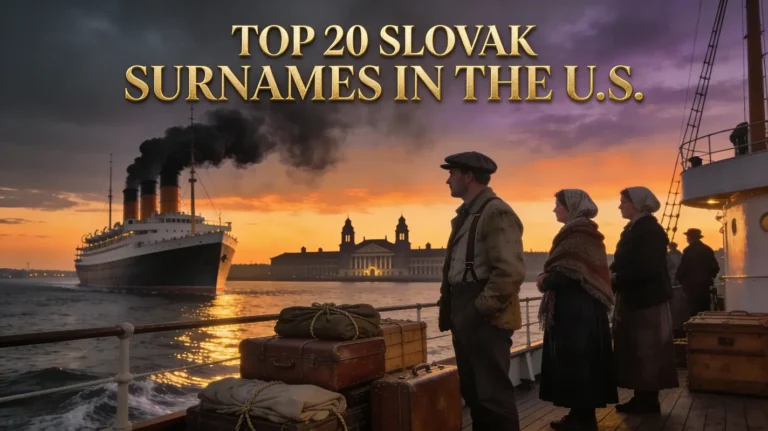
- Emigration, especially to the U.S. between roughly 1880–1924, when clerks simplified or altered names for American records.
2. If Your Surname Comes From a Job
Occupational surnames tell you what someone in your direct male line once did for a living.
Typical Slovak and Hungarian occupational forms include:
- Kováč / Kovac / Kovacs – smith
- Molnár / Molnar – miller
- Varga – shoemaker / cobbler
- Szabó / Sabo / Szabo – tailor
- Mlynár / Mlynar – miller (Slovak form)
- Pekár / Pekar – baker
What it says about your ancestors:
- Your male line had a defined craft that was central to local economy (smiths, millers, tailors were nodal people in the village).
- Your ancestors likely appear frequently in contracts, tax records, and disputes, because tradesmen interacted with local authorities more than landless laborers.
- Occupational names are geographically widespread, so the surname alone rarely narrows you to one region; you need village names from records.
For U.S.-based descendants, the Americanized versions (Kovach, Molner, Sabo, Pekar) still point back to a concrete craft in a Slovak or mixed Slovak–Hungarian village.
3. If Your Surname Comes From a Place
Some surnames come from villages, regions, or geographic features. These are powerful clues because they can literally name the area your line once came from.
You’ll see:
- Surnames built from town names or regions, often with -ský / -sky / -ski endings.
- Names referring to a landscape feature: Vrch (hill), Potok (stream), Most (bridge), Luka (meadow), etc.
What it says about your ancestors:
- Your surname may encode the original village, a neighboring parish, or the region your family moved from.
- -ský / -sky endings often mean “from / associated with,” a direct pointer to a place or noble estate.
- In some cases, place-based surnames show internal migration even before emigration – a family moved and was labeled by their new neighbors as “the ones from X.”
In American records, these names might be partially translated, simplified, or split (e.g., village part dropped, only -sky kept). Rebuilding the original form is key to finding the right parish.
4. If Your Surname Comes From a Personal Name
Another large group derives from given names – the first name of an ancestor became the family surname.
Examples (Slovak / Hungarian / general Central European types):
- Janoš, Janosik, Janosek – from Ján / János (John)
- Marek – from given name Marek (Mark)
- Juraj → Jurik, Jurčík, Juriga
- Michal → Michalik, Michalík
- Štefan → Štefánik, Šefčík
What it says about your ancestors:
- The surname points to a strong ancestor with a common given name whose descendants were labeled by his personal name.
- The specific ending (-ík, -ik, -ek, -ik, -čík) often reflects dialect and region, helping you narrow down to western, central, or eastern Slovakia.
- These surnames tell you less about occupation, more about kinship and local social structure – a given name strong enough that it stuck as a family identifier.
For U.S. descendants, the risk is that the base name (John, Michael, Stephen) is extremely common, so you must not chase everyone with a similar surname – you need a village tie.

5. If Your Surname Is a Nickname or Character Trait
Many Slovak surnames started as nicknames describing some trait, habit, or physical detail.
Patterns include:
- Physical traits: small, tall, red-haired, one-eyed, limping.
- Character traits: quiet, stubborn, clever, talkative.
- Animal-based nicknames: wolf (Farkaš/Farkas), bear (Medveď), fox (Líška), sparrow (Vrabec), etc.
What it says about your ancestors:
- You are probably descended from someone whose appearance or personality stood out enough that neighbors turned it into a permanent label.
- Animal names often carry an implied trait: wolf (strength, fierceness), fox (cunning), stork (small), and so on.
- These surnames can be very localized – they sometimes indicate a tight cluster in one village or small group of villages.
For Americans, these names are strong hooks for storytelling (“my surname literally means wolf”) and for explaining to relatives how surnames were born in a village setting.
6. What the Language of Your Surname Hints At
Even if your ancestors identified as Slovak, the surname’s form may look Hungarian, German, or Slavic-without-diacritics. That is not a contradiction; it describes the political and linguistic environment of the time.
Common patterns:
- Hungarian-looking surnames (Nagy, Tóth, Varga, Szabó, Molnár) borne by families from Slovak-speaking villages.
- German-looking surnames (Roth, Klein, Bauer, Weber) in Slovak towns with German burgher or Jewish populations.
- Slavic names lacking accents (Horvath, Kovac, Novak, Balaz) in U.S. records because American systems dropped diacritics.
What it says about your ancestors:
- Your family lived in a multi-lingual environment where administration, education, and church life could run in Hungarian, German, Latin, or Slovak.
- Identity in records may shift: the same person might be listed as “Hungarian” in one document and “Slovak” or “Czechoslovak” in a later census.
- Jewish, German, Slovak, and Rusyn families often shared similar-looking surnames, so religion and village are as important as the name itself.
This means your “Slovak surname” can expose ethnic mixing and shifting state borders rather than a neat single-ethnicity story.
7. What Americanization Did to Your Surname
If your family came through Ellis Island or other U.S. ports between about 1880 and 1924, your surname likely changed on the way in or a few years later.
Typical changes:
- Diacritics removed: Kováč → Kovac; Horváth → Horvath.
- Phonetic spellings: Lukáč → Lukach; Farkaš → Farkash / Farkas; Štefan → Stefan.
- Translations: Mlynár → Miller, Pekár → Baker.
What it says about your ancestors:
- Someone in your line either accepted the new form or actively chose it to fit in, get work, or avoid discrimination.
- Different branches may have diverged: cousins from the same village can carry different spellings in the U.S., even though they share the original surname in Slovakia.
- The further back you go, the more critical it is to rebuild the original spelling before you search Slovak church and civil registers.
For genealogical work, this is often the main bottleneck: once you restore the diacritics and original language form, the records open up.
8. How Much Can a Surname Alone Tell You?
Your Slovak surname gives you direction, not a complete answer.
With only the surname, you can usually infer:
- Likely type of origin (occupation, place, personal name, nickname).
- Rough linguistic environment (Slovak, Hungarian, German, mixed).
- Sometimes a probable region inside Slovakia, especially with strongly regional forms.
You cannot reliably infer:
- Exact village or parish without at least one record stating it.
- “Pure” ethnicity – many families were bilingual or changed self-identification across decades.
- Single, neat story – the same surname can arise independently in different places.
The real value of your surname is as a starting hypothesis: it tells you where to look first, what alternate spellings to test, and which church books and archives deserve your time.