If you’re researching Slovak ancestors, you will run into a village with several different names. Sometimes ten or more. It’s not a mistake. It’s how Central Europe worked. If you don’t understand why village names shift, you will search in the wrong place, miss records, or assume the village “doesn’t exist.”
Here’s the reason behind the chaos.
1. Multiple Languages in One Region
Slovakia was part of the Kingdom of Hungary for centuries. Administration, church life, education, and politics used different languages at different times:
- Latin
- Hungarian
- Slovak
- German
- Rusyn
- sometimes mixed within one record book
Each language had its own spelling rules. The same village could appear as:
- a Latin version in church books
- a Hungarian version in civil records
- a Slovak version on modern maps
- a German version in historical German-speaking communities
Impact: One location generates several official spellings without anyone changing the village itself.
2. No Standardized Spelling Until the 20th Century
Modern Slovak orthography stabilized late. Before that:
- priests wrote phonetically
- clerks used whatever spelling they preferred
- Hungarian officials applied Magyar spelling conventions
- German administrators used German phonetics
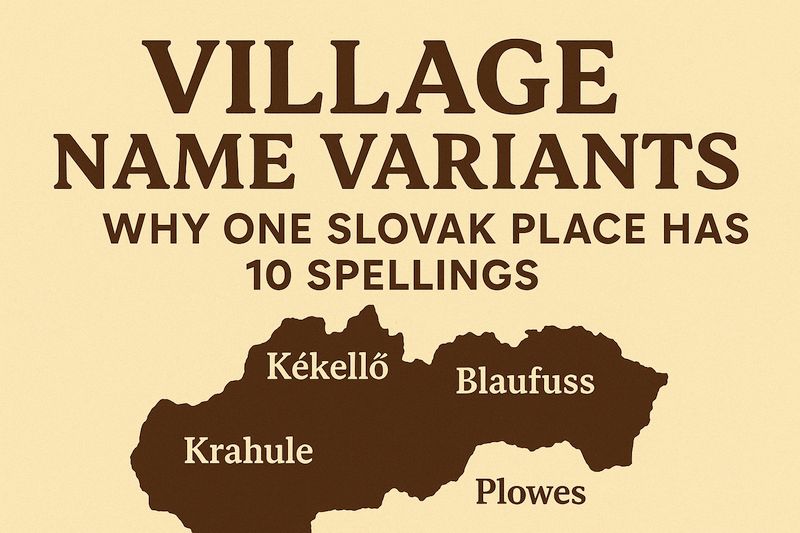
If a place was called Krahule, a Hungarian clerk could write Kékellő, and a German clerk could use Blaufuss. You might even find Plowes. All refer to the same place.
Impact: You must expect variation, not consistency.
3. Political Changes Forced New Names
Village names changed with every major political shift:
- Kingdom of Hungary to Czechoslovakia (1918)
- First Slovak Republic (1939–1945)
- Czechoslovakia (1918-1939, 1945–1992)
- Post-1993 modern Slovakia
Each regime introduced its own naming policies. Some names were Slovakized, others restored to older forms, and others replaced entirely.
Impact: A village can have separate names for different political periods.

4. Hungarianization and Slovakization Policies
During the late 19th century, Hungary pushed Magyarized place names. After 1918, Czechoslovakia reversed many of them. Example:
- Urmín → Ürmény→ Mojmírovce
- Pozsony → Pressburg (German) → Bratislava
This wasn’t cosmetic. It was part of national identity politics.
Impact: If you only search for the modern Slovak name, you miss older records indexed under the Hungarian name.
5. Local Dialects Created Unofficial Variants
Villagers often used names that never appeared in official documents:
- dialect forms
- shortened forms
- older regional forms
- nickname-style village names
Example: Vyšná Boca can appear as Felsőboca, Felső Bocza, Királyboca, Kráľovská Boca depending on the writer.
Impact: You may find entries that look like a different village, but it’s still the same place.
6. Parish and Civil Authorities Used Different Names
Church parishes didn’t always follow the same naming conventions as civil offices. In baptism, marriage, or burial books, priests often kept Latin names long after civil authorities switched to Hungarian or Slovak forms. Although Hungarian and Latin were the most used church languages, Evangelical church often used Slovak language, which might surprise you if you encounter it.
Impact: One parish register can have a name that doesn’t match the village name used in civil documents of the same period.
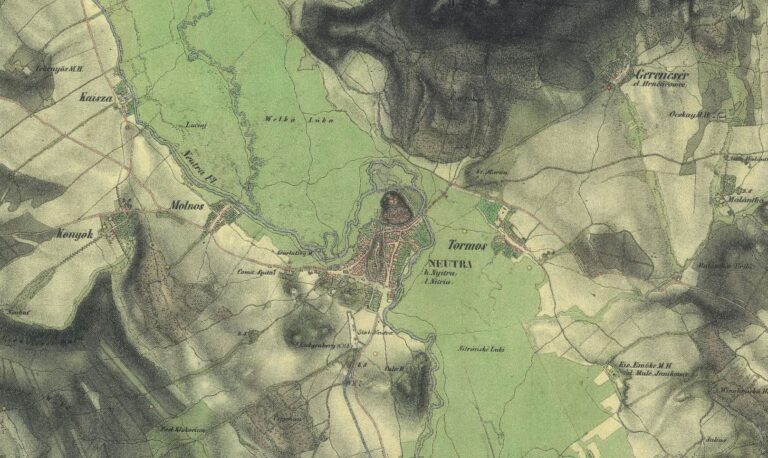
7. Maps Were Produced in Different Languages
Historical maps from the region were printed by:
- Hungarian cartographers
- Austrian military surveyors
- German publishers
- Czechoslovak offices
Each labeled the same locations using their own system.
Impact: One map uses the Hungarian form; another uses the German equivalent; a modern map uses Slovak.
How This Affects Your Genealogy Research
If you don’t know all variants of your ancestor’s village, you can’t find the right records. Search engines won’t help you unless you feed them all possibilities. Most American researchers fail here because they search only the modern name.
To stay efficient:
- learn the Hungarian, Slovak, German, and Latin variants
- understand historical county (Hungarian: megye) and current district assignments
- identify parish affiliation and its historical names
- check military maps from multiple periods
- cross-reference GPS coordinates, not just names
This removes 80% of “mystery village” problems.
Use This to Speed Up Your Research
I built a complete system of Slovak village name variants, historical counties, parish assignments, and GPS coordinates. It’s designed specifically for Americans researching Slovak ancestry.
If you want to avoid hours of searching for one village name, get my ebooks and reference guides. They give you:
- all major village name variants
- historical Hungarian and Latin forms
- clear mapping of parishes and archives
- workflows to avoid location errors